Training for the Next Thirty Years
How intention, intent and intensity change with age, and what appropriate challenge actually looks like over months, not sessions.
If the goal is more life, not a better six weeks, training after forty has to change. Not necessarily less. Differently.
If you accept the idea of a physical pension—that strength, fitness and confidence are assets built through repeated contributions, rather than something you either have or do not—a practical question follows immediately.
Fine. So how do I actually train?
Not which exercises. Not which programme. Something underneath that: what has to change about the way you approach training once the goal stops being a shorter-term look and becomes decades of physical capacity?
I think about that shift through three things: intention, intent and intensity.
They sound similar. They are not.
And understanding the difference is more useful than any single programme I could give you.
Intention, intent and intensity
Intention is what the training is ultimately for.
In my twenties, the intention was performance and, if I am honest, quite a lot of ego. I wanted to become better at boxing, kickboxing and jiu-jitsu, and I wanted to look like someone who trained.
There is nothing wrong with either of those things. But almost every decision in the gym answered to what I wanted to achieve now.
At forty-one, performance still matters to me. So does ego, if I am being honest about that too. But the intention has widened.
I now have a second eye on longevity.
What do I need to do today so that I can still train at fifty, sixty and seventy?
That question was not in the room in my twenties. It is in almost every session now.
Intent is the purpose and quality you bring to the work in front of you.
It is the difference between simply completing a set and knowing what the set is supposed to develop. The exercise, technique and effort should all point towards the same outcome.
My intent has become more precise with age, not less aggressive.
I waste fewer repetitions. I am less interested in training that is difficult but directionless. I pay more attention to how I move, what I am trying to improve and whether the work I am doing actually supports the wider intention.
Intensity is how demanding the work is relative to your current capacity.
Intensity still matters. Strength, fitness and resilience are not built by permanently staying comfortable.
But intensity has to be placed deliberately.
Hard sessions need a reason. Easy sessions need a purpose. Recovery has to be treated as part of the programme rather than something that happens after the programme is finished.
In my twenties, intensity was mostly just high.
Hard sessions on consecutive days. Sometimes twice in one day. Very little thought given to warm-ups, injury history or whether I had stacked too much stress too close together.
My body absorbed many of the mistakes I did not know I was making.
That approach became less reliable as I accumulated more training history, more responsibilities and more injuries worth paying attention to.
Now, if a hip feels stiff on Tuesday, I treat it as information. I assess it during the warm-up. If it settles, I continue. If it does not, I adjust the session.
The goal is not to obey every sensation. That can become avoidance dressed up as wisdom.
The goal is to stop ignoring useful information.
Age has not removed the need for effort.
It has removed some of my tolerance for effort without thought.
Appropriate challenge
Growth requires challenge. That remains true at any age.
But the challenge has to be appropriate—just above where the person actually is, not wherever creates the most dramatic moment.
If someone can lift 100 kilograms well, the next useful challenge might be 105.
A poor coach loads 120 onto the bar because it looks more impressive, or because the coach needs the moment more than the client does.
That is not coaching.
That is someone using another person's body to make themselves feel useful.
I have made a version of that mistake myself.
Not necessarily with weight, but with words—pushing someone harder than they were ready for because I needed to prove something, rather than because it was the right next step for them.
It did not build anything.
It simply made someone feel small in a room where they were trying to feel safe enough to grow.
Appropriate challenge is not soft coaching. It is still challenge.
It means asking enough of someone to create adaptation without asking so much that the cost overwhelms the benefit.
That distinction is what separates training that compounds over years from training that burns someone out inside a season.
And it requires knowing the person in front of you—not a generic idea of what a forty-five-year-old, sixty-year-old or seventy-year-old should be capable of.
What this looks like over months, not sessions
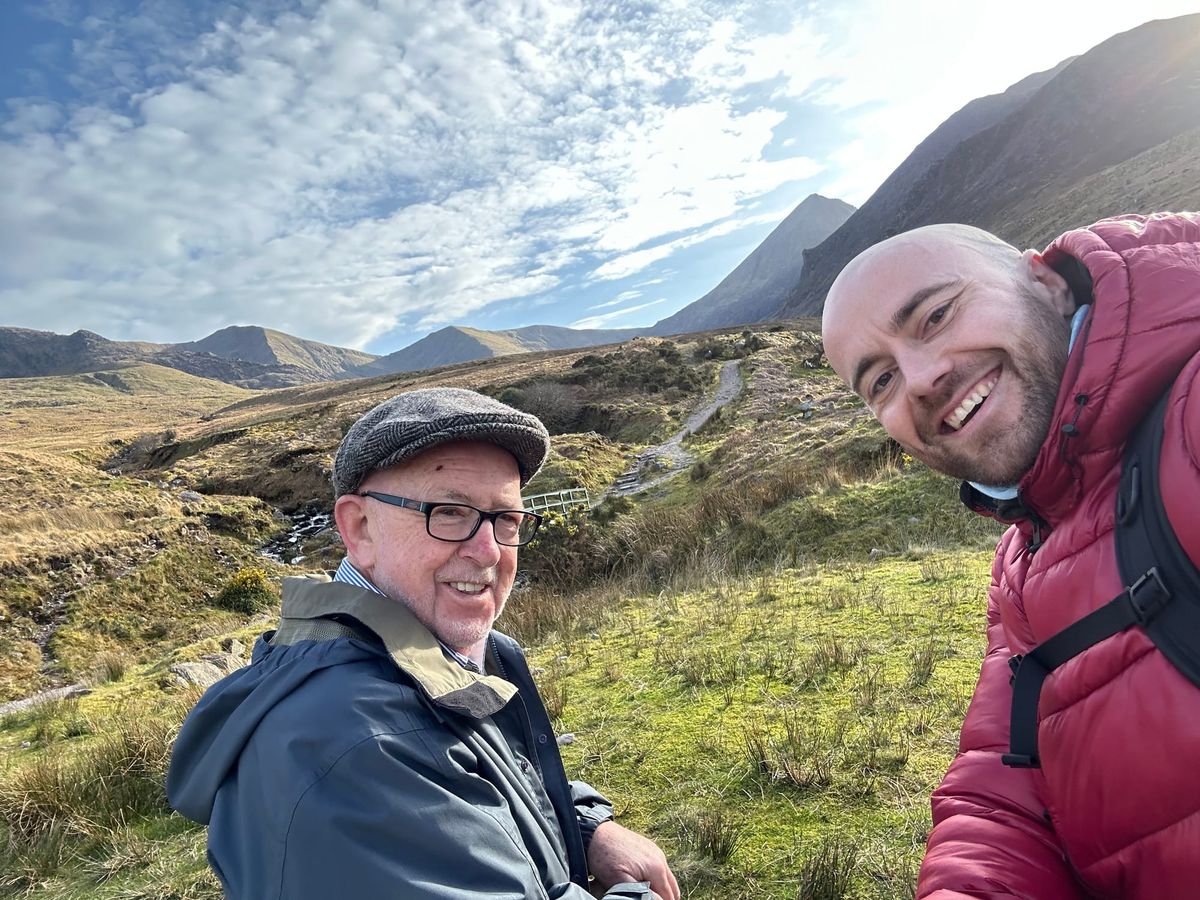
A few years ago, we were preparing for the Four Peaks Challenge—climbing the highest mountain in each Irish province inside twenty-four hours.
Before the event, we planned to climb each mountain once as a recce.
One day in the gym, half-serious, I asked Derek—seventy-four at the time—whether he wanted to come and climb Carrauntoohil with us.
He looked genuinely unsure.
"I don't know," he said. "Would I be able to do that?"
I told him I believed he could.
We would prepare properly. We would control the pace. I would help him if he needed it, and we would turn back if the mountain gave us a reason to.
The truth was that I could not guarantee he would make it.
What I did know was that we could build the conditions that gave him a real chance.
Appropriate challenge is not only about the weight on a bar. It is about designing the whole situation so fear alone does not decide the outcome before capability has been properly tested.
We did not get Derek ready for a mountain in one session.
It took months of training beforehand—building the specific capacity that climbing Carrauntoohil would require, rather than vaguely trying to "get fitter."
Steady progression. Work adjusted around him rather than around what would look impressive. Enough challenge to move him forward, but not so much that one ambitious week undermined the next month.
About fifteen of us climbed together.
Derek made it to the top.
He sat down, pulled out a tuna sandwich he had packed for himself and ate it looking out over Kerry.
Near the end of the day, sitting on a bench as the sun began to go down, he turned to me.
"The reason I climbed that mountain," he said, "is because you told me I'd be able to do it. Because you told me I'd be able to do it, I believed I could do it."
That is not really a story about mountains.
It is a story about what appropriate challenge, applied consistently over months rather than demanded in one dramatic session, can produce.
Nobody reaches seventy-four and climbs Ireland's highest mountain because of one heroic workout.
They get there because months of ordinary sessions gradually make an extraordinary day possible.
I've written elsewhere about what the physical pension is actually made of—strength, cardiovascular capacity, movement quality and expression. This is about something different: how the contributions to it need to change shape as you get older, and as the season you're in changes too.
The mountain, for Derek, was expression. Everything before it was a different season of training entirely.
Training has seasons
The second practical shift is accepting that training should not look the same all year.
Nature has seasons, and so does a useful training life.
Those seasons are not necessarily tied to the calendar. January does not always have to be for building muscle, and summer does not always have to be for endurance.
A training season is simply a period in which one outcome receives more attention than the others.
One of the biggest mistakes people make is trying to improve everything maximally at the same time.
They want to gain muscle, become stronger, increase aerobic fitness, train for a race, improve mobility, lose body fat and recover from an injury—all inside the same twelve-week block.
That is not ambition.
It is poor prioritisation.
You can continue touching all the major qualities, but they cannot all be the main priority at once.
There may be a building season, where the emphasis is on adding muscle, developing strength, improving movement options and establishing an aerobic base.
There may be an expression season, where those general qualities are directed towards something specific: a mountain, a competition, a cycling event, a long hike or another meaningful physical goal.
There may be a maintenance season, when work, family or life reduces the training load you can reasonably absorb.
The goal during that period may simply be to retain the assets you have already built.
And there may be a restoration season, after an injury, illness, competition or difficult period, when fatigue needs to come down and basic capacity needs to be rebuilt.
None of those seasons is wasted.
Maintenance is not failure.
Recovery is not laziness.
Focusing on one quality for a period does not mean abandoning everything else.
The skill is knowing what season you are in—and not judging it by the standards of a different one.
Someone in a restoration season should not judge themselves against their best performance season.
Someone trying to build strength should not panic because their endurance is not improving at the same rate.
Someone in a demanding period of work or family life may be doing extremely well simply by maintaining two strength sessions and enough weekly movement to keep the floor from dropping.
Training for the next thirty years means moving between these seasons deliberately.
Build when you can build.
Express those capacities in ways that matter to you.
Maintain them when life becomes crowded.
Rebuild when something has been lost.
The physical pension is not created by trying to peak every quality, every week, forever.
It is created by keeping the important assets alive while changing the emphasis according to the person, the goal and the season.
What changes in practice
Training for the next thirty years does not require a complicated system.
It requires better judgement.
Keep the purpose connected to a life outside the gym.
Train hard enough to create adaptation, but do not confuse suffering with progress.
Distribute hard, moderate and easy work deliberately rather than allowing every session to become a test.
Progress from the capacity you have now, not the person you used to be or the person beside you.
Adjust around injuries and readiness without becoming ruled by every ache, stiffness or moment of uncertainty.
Accept that some seasons are for building and others are for holding on.
And continue challenging yourself.
Appropriate challenge is still challenge.
Training after forty should not become an extended warm-up for the rest of your life.
But challenge should build something.
It should not exist merely to prove that you can survive it.
The next thirty years
The physical pension only pays out if the contributions are appropriate for the person, the goal and the season.
That is the shift.
Not less ambition.
Not less effort.
Better judgement about where that effort belongs.
Derek did not climb Ireland's highest mountain because of one extraordinary session.
He climbed it because months of ordinary work gradually made an extraordinary day possible.
Your next step does not need to be a mountain.
It needs to be appropriate to where you are, connected to where you want to go and followed—when you are ready—by another one.